Your customers ask AI. Your business answers.
No code, no technical setup. You give Fugentic the detail only you have — what you sell, what it costs, the jobs you take on and the ones you turn down — and it becomes a hosted MCP server an AI assistant can ask directly. The customer on the other end gets your answer, in your words.
Built on Agentic Resource Discovery (ARD) — an open standard for describing what an AI resource can do, drafted by Google, Microsoft and Hugging Face.
Why now
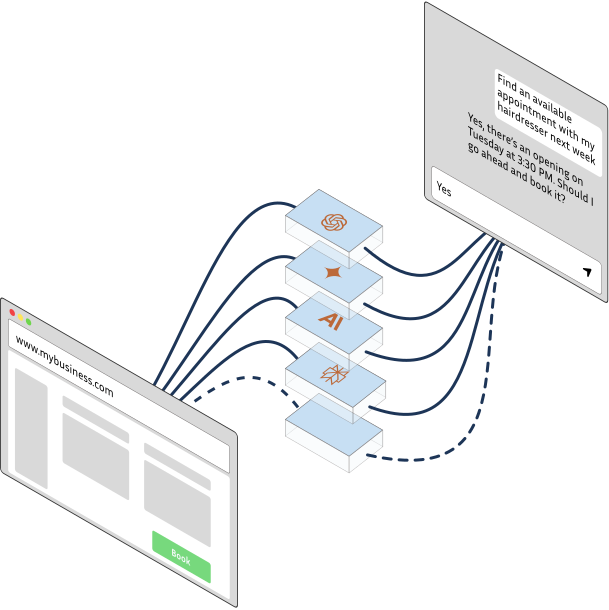
Search engines were the front door for 20 years. Your customers are switching to AI.
of consumers have replaced search engines with AI for product and service recommendations
admarketplace, 2025year-over-year increase in traffic to businesses from generative AI sources
Adobe, 2025of consumers now start their search journey in AI — not Google
Search Engine Land, 2025of shoppers use AI for product and business discovery (54% among Gen Z)
Salesforce, 2025Someone asks for exactly what you sell. What decides the answer?
When a customer asks an AI assistant like Claude or ChatGPT for exactly what you offer — "find me a plumber near Copenhagen" — your business has to be described in a way the assistant can match and act on. That is what the guided setup is for.
How it works
Three steps, none of them technical
You describe your business, your brand, products and services. Nothing technical is left for you to do.
- 01
Describe your business
Your services, prices, where you work, what you take on and what you turn down — entered through a guided setup. No SDK, no engineering.
- 02
We host it and keep it answering
The platform turns what you entered into an MCP server, runs it around the clock, and keeps it valid as the open standard changes.
- 03
Assistants can find it and ask
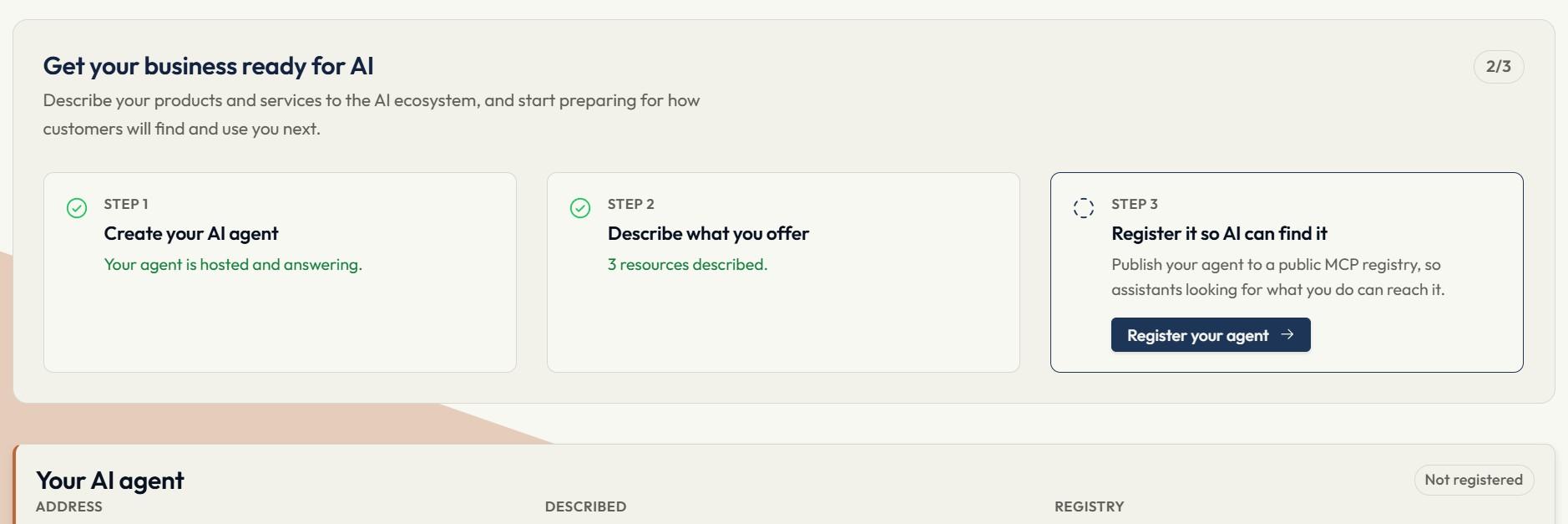
Your server is registered into MCP Register — the open registry that agent finders read. That registration is what puts you in the running, and when an assistant does ask, your business answers in its own words and points the customer to the next step.
The guided setup
If you can explain your business, you can set this up
The platform asks in plain language, one thing at a time — no code, nothing to install. You answer the way you would for a new employee on their first day, and what you type becomes something an assistant can read.
Your services and offerings
What you sell, in the words your customers actually use to ask for it.
What you take on — and what you don't
The jobs you want, the ones you turn down, and what you need to know before you can price something.
Your business data
Prices, service areas, opening hours, policies — the details an answer needs to be useful.
How you want to be represented
How your business describes itself, and where a customer question should go next.
Free to start
Your first MCP server is free
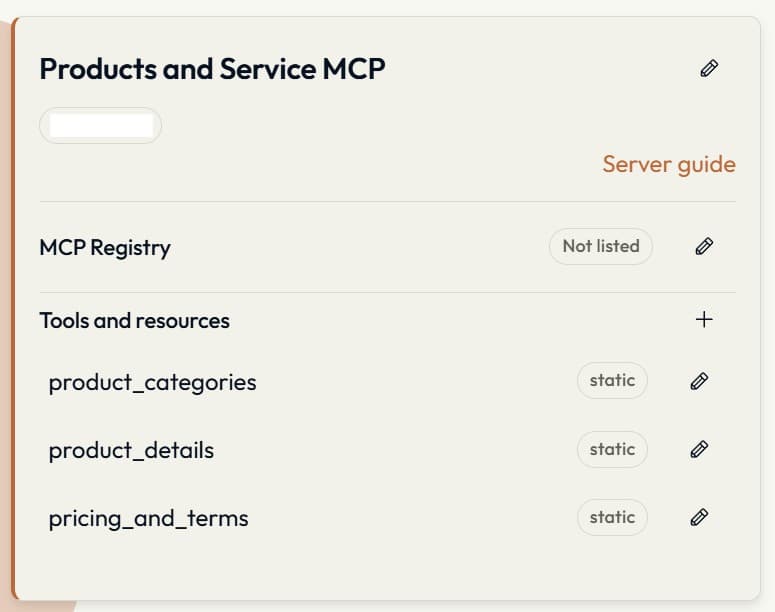
One hosted server per account. It answers questions about what you offer, where you work and how you price — which is what an assistant needs before it can recommend you to the customer asking.
What you get
- Hosted and kept answering, around the clock
- Registered into MCP Register, the open registry agent finders read
- Kept valid as the open standard changes
- Insights, so you can see which AI assistants reach it and which of your answers get used
Where it stops today
Today your server answers questions about your business. It cannot act on them yet — no bookings, no orders, no payments.
Open standard
Built on an open standard
Agentic Resource Discovery (ARD) is an open standard for describing what an AI resource can do — published by Google, Microsoft and Hugging Face, and developed with Cisco, Databricks, GitHub, GoDaddy, Nvidia, Salesforce, ServiceNow and Snowflake. It can describe almost any kind of AI resource. Nearly every one built so far was made by engineering teams, for other engineers. Fugentic makes the other kind: one built by a business, for its own customers.
Read the full explainer on ARD →Who is behind Fugentic →
Browse by industry
Customers are asking AI for your industry
Click your industry to see how businesses like yours make their services available to AI.
Straight answers
Nothing. You get one hosted server per account — set up, hosted and kept answering.
No. You describe your business in plain language through a guided setup, and Fugentic hosts it, registers it and keeps it live. No code, no SDK, no servers to manage.
Being registered makes you findable; it cannot make an assistant choose you. What decides that is how well your description matches what someone actually asked — which is why the setup pushes for specifics rather than a tagline.
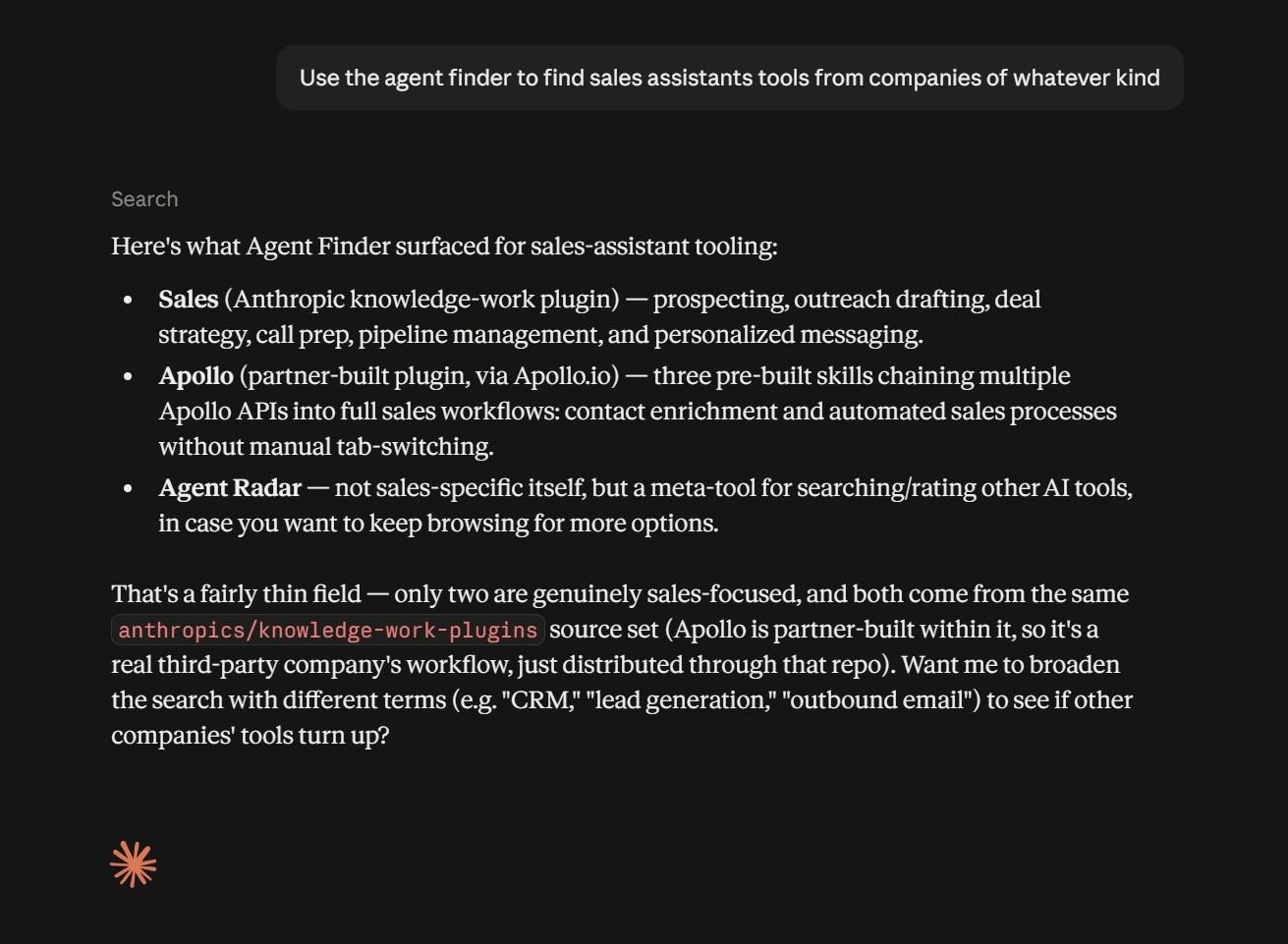
Any assistant whose agent finder reads MCP Register, where your server is registered. It seems GitHub’s agent finder already reads it; support across the rest of the ecosystem is still new.
A search listing waits for someone to click. This makes your business something an assistant can ask directly — so when it is working out who can help with a task, yours is one it can put a real question to.
It is the standard way for an AI assistant to ask a question of something outside itself and get a structured answer back. Yours holds what you sell, what it costs, where you work and what you take on — so an assistant can ask your business instead of guessing from whatever it found on the open web. You do not build or manage it; you describe your business and Fugentic hosts the server.